
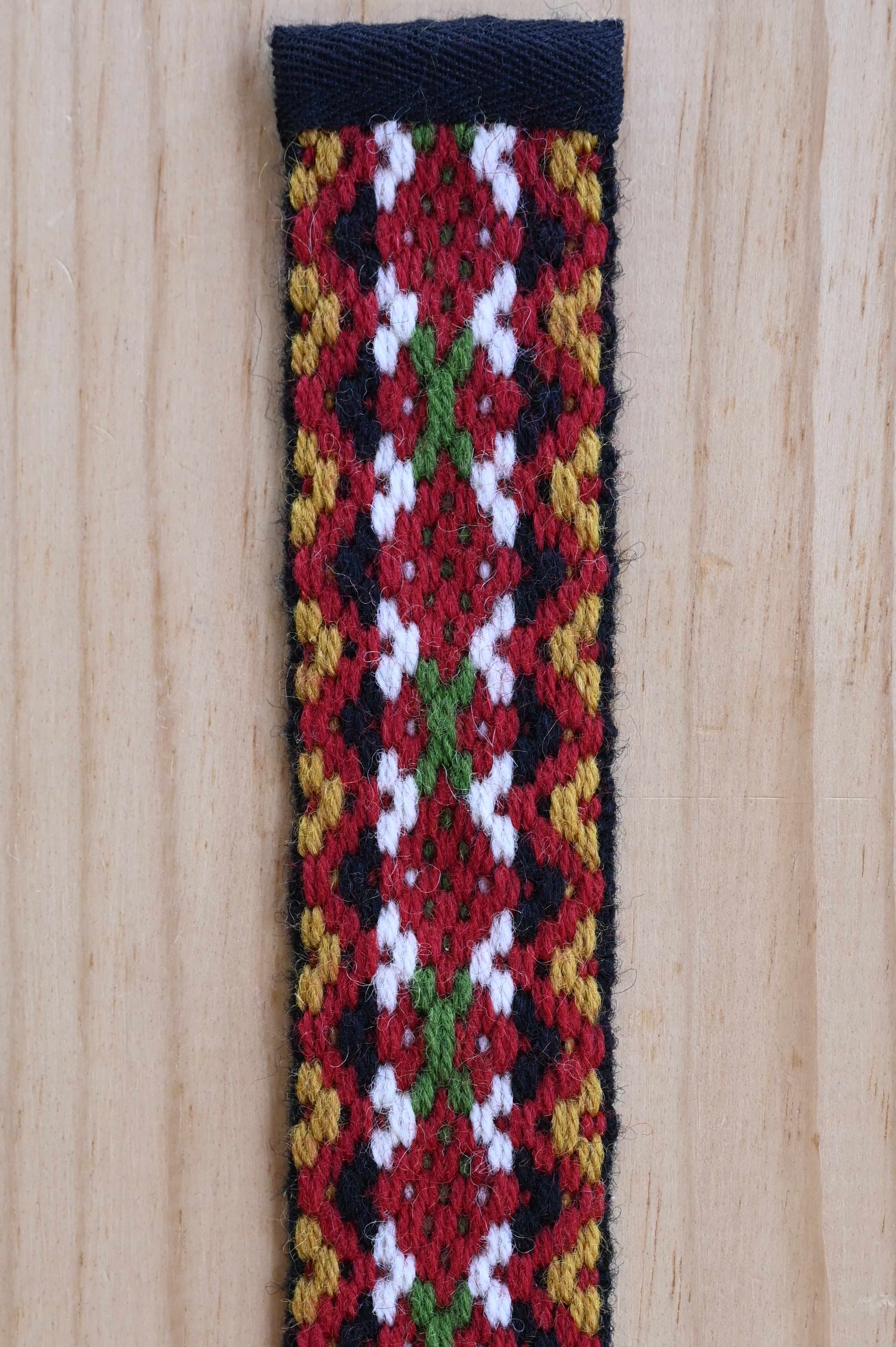
Pick-up sample. After suspenders, NFM.1979-04131, Nordfjord Folkemuseum.
In preparing to present a webinar for Vesterheim on Norwegian bandweaving, September 21, 2025, I was intrigued with the pattern in a pair of suspenders from the Nordfjord region of Norway that I’d chosen to illustrate my talk. So I charted the pattern from the photograph and wove the above sample to the same width as the original. You can see the original at https://digitaltmuseum.no/011025121570/buksesele. They are believed to have been bridegroom’s suspenders.
This is a more complex version of the Type 1 pick-up technique with offset rep threading shown in my book, Norwegian Pick-Up Bandweaving, in Figs. 122 and 130—more complex because there are more warp ends, more color shifts in the threading, and more rows in the pattern repeat—but if you’re familiar with this technique, it’s a beautiful pattern. Here are the specs and chart for my sample.
Yarn: Rauma 3tr. Strikkegarn, 100% Wool, ca. 105m 50g.
101 White
136 Black
144 Red
145 Green
146 Gold
Width: 64 ends, 4cm wide.
Warp Color Order:
2 Black (selvedge)
(1 Gold, 1 Red) x4
(1 Red, 1 Black) x4
(1 White, 1 Red) x4
(1 Green, 1 Red) x6
(1 White, 1 Red) x4
(1 Red, 1 Black) x4
(1 Gold, 1 Red) x4
2 Black (selvedge)
The chart below shows four rows woven plain at the bottom, then 20 rows with the pick-ups marked with caret symbols. The same 20 rows of pattern are repeated throughout.
As is customary for charts for this weave, one vertical row of squares represents one pair of adjacent warp ends (let’s say one gold and one red, for example). If a square is colored gold, the gold warp end of the pair is above the weft on that shot. If the square is colored red, the red warp end of the pair is above the weft on that shot. Once you start weaving, this will make sense, and the plain rows at the bottom of the chart will help you get your bearings and begin making pick-ups on the correct shed.


Leave a Reply